Direction Magazine Articles
The Flapper Magazine Articles
La Baionnette Articles
Pic Magazine Articles
Touchstone Magazine Articles
Collier's Magazine Articles
Click Magazine Articles
Confidential Magazine Articles
The American Legion Monthly Articles
Confederate Veteran Magazine Articles
The American Legion Weekly Articles
The Dial Magazine Articles
Harper's Bazaar Magazine Articles
Current Literature Magazine Articles
The Smart Set Articles
Punch Magazine Articles
Creative Art Magazine Articles
The Film Spectator Magazine Articles
Vogue Magazine Articles
Rob Wagner's Script Magazine Articles
Men's Wear Magazine Articles
Photoplay Magazine Articles
Vanity Fair Magazine Articles
The Atlantic Monthly Articles
Outing Magazine Articles
The Saturday Review Articles
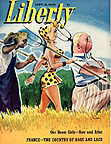
Liberty Magazine Articles
Film Daily Magazine Articles
Stage Magazine Articles
G.I. Joe Magazine Articles
Life Magazine Articles
Trench Warfare Articles
Leslie's Magazine Articles
Sea Power Magazine Articles
Scribner's Magazine Articles
Freedom's Triumph Articles
Outlook Magazine Articles
Harper's Weekly Articles
The Saturday Evening Post Articles
Theatre Arts Magazine Articles
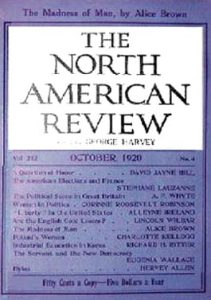
The North American Review Articles
PM Tabloid Articles
The National Park Service Articles
The New Republic Articles
Ken Magazine Articles
The New York Times Articles
47 Magazine Articles
Newsweek Articles
People Today Magazine Articles
Hearst's Sunday American Articles

F.D.R.

FDR Compared to Lincoln

An anonymous Philadelphia journalist, dumbstruck by the sudden death of FDR, compared the fallen president to Abe Lincoln because both were successful military leaders. He goes a step further by insisting that Walt Whitman’s famous ode to Lincoln is equally applicable for FDR.

High Hopes for Child Welfare
(Collier’s Magazine, 1940)

In this 1940 article, Eleanor Roosevelt (1884 – 1962) argues for a benevolent government that would see to the prenatal needs of expectant mothers and their growing children:


“But all children, it seems to me, have a right to food, shelter, an equal opportunity for education and an equal chance to come into the world healthy and get the care they need through their early years to keep them well and happy.”

Sticking It to FDR
(Liberty Magazine, 1942)

George Creel (1876 – 1953), the nation’s first and only official censor (1917 – 1918), knew FDR for twenty-five years, and in this wartime recollection he made FDR wish that the two had never met. This is the type of article Creel would never have allowed to be published twenty some years earlier because it sought to reduce confidence in the Commander-in-Chief. Yet, with the war in its eleventh month, Creel gave it to FDR with both barrels:


“No man ever dreamed more nobly or had less skill in making his dreams come true.”

Advertisement

Use shortcode [oma_ad position="summary_top"] (or other position) in your theme or widgets to display OMA Promotions here.

FDR’s Proposal to Limit Personal Income
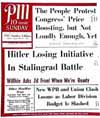
(PM Tabloid, 1942)

By the end of the war, FDR’s administration had placed taxable personal income as high as 94%(!). His Brain Trust were all big believers in Federal intervention into the economy – offering all sorts of price freezes and wage freezes in order to limit competition during the Great depression (as if that was a good). As the war kicked-in to high gear, FDR installed a low ceiling upon all high-earners and capped their salaries at $25,000.00 per-year.


Click here to read about FDR’s airplane.

FDR in W.W. I
(Liberty Magazine, 1942)

Between the years 1913 through 1920, FDR served as Assistant Secretary of the Navy under Josephus Daniels:


“Roosevelt had not been in office a month before he gave out a public statement urging a more adequate navy:”


“‘The navy is not fit for war. We have today only sixteen ships we can send effectively against the first line of the enemy.'”

They Protected FDR
(Coronet Magazine, 1945)

Five months after the death of President Roosevelt, writer Michael Sayers (1911 – 2010) managed to get this FDR article to press while the public’s interest in the man was still hot. It addressed the tremendous lengths the Secret Service went to on a daily basis to protect President Roosevelt from Axis assassins and general kooks who wanted a shot at him:


“The White House detail, headed by six-foot Michael Reiley (1909 – 1973), stayed beside the President at all times. They became his shadows, unseen in the public glare, but always at hand… The President was not permitted to set foot in any place that had not been thoroughly investigated beforehand.”

Advertisement

Use shortcode [oma_ad position="summary_top"] (or other position) in your theme or widgets to display OMA Promotions here.

His Mail
(Spot Magazine, 1941)

Unlike his many predecessors, FDR used to encourage the American people to write him with their thoughts. At times, the President used to boast to Congress concerning the volume of his mail in favor of his programs, but the mails did not simply deliver stamped envelopes:


“Almost anything you can think of has arrived as a gift at some time or another – dogs, sheep, eagles, baby chicks, toads, alligators. Mr. Roosevelt has never received any lions, but Calvin Coolidge got two, from Johannesburg…”

Amateurs All
(Collier’s Magazine, 1935)

“The Brain Trust’s very lack of practical experience was its chief asset. Unhampered by tradition and fairly drunk with the opportunity of translating college dreams into realities, they leapt to the battle, careless of obstacles and without fear of frustration.”

Harold Ickes: FDR’s Gas Czar
(Liberty Magazine, 1942)

This article was published one month after the start of the war; it must have been a time when everyone had something to say about Harold Ickes (1874 – 1952) as he was composing the gas rationing laws for the home front. In this column, Ickes speaks for himself. He had been the one who saw to the President’s energy policy’s during the Great Depression and now he was FDR’s go-to-guy for gas during the war.

Advertisement

Use shortcode [oma_ad position="summary_top"] (or other position) in your theme or widgets to display OMA Promotions here.

”If Lincoln Were in the White House”
(Liberty Magazine, 1936)

By cleverly borrowing from the state paper, letters and speeches of the Great Emancipator, a journalist from the usually pretty anti-New Deal Liberty Magazine was able to piece together a few paragraphs indicting
what they hoped Lincoln would think of the New Deal.

The Brain Trusters
(New Outlook Magazine, 1934)

A year and a half into FDR’s first term, journalist William E. Berchtold caught wind of a growing realization in Washington that most of the ’emergency’ legislation will become permanent. This didn’t bother him nearly as much as the fact that such imperishability also meant that the host of beta males who were positioned to maintain this behemoth would also be remaining (History has taught us that it was not FDR’s alphabet agencies that became a mainstay, but those of LBJ).

Advertisement

Use shortcode [oma_ad position="summary_top"] (or other position) in your theme or widgets to display OMA Promotions here.

The Junior Brain Trusters
(New Outlook, 1934)

I have gathered my tools and my charts… I shall roll up my sleeves – make America over!

This was the motto to which the young folk began their work, nearly a thousand of them, which may be grouped for study purposes under the generic title, ‘Junior Brain Trusters’. They were, for the most part, young men from the colleges and universities of the larger eastern cities…. Many of them came as protégés of the Senior Brain Trusters themselves, brought from the classrooms by [Guy] Tugwell, [Raymond Charles] Moley, [Felix] Frankfurter – Professor Frankfurter being especially successful in drafting students and recent graduates from the Harvard Law School.

‘The Black Brain Trust”
(The American Magazine, 1943)

The Black Brain Trust consists of about 25 Negro leaders who have assumed command of America’s 13,000,000 Negroes in their fight for equality. They hold informal meetings to plan their strategy, whether it is to defeat a discriminatory bill in Congress or to overcome a prejudice against a private [in the army]. Few white men know it, but they have already opened a second front in America – a front to the liberation of the dark races.


More on this topic can be read on this website…

The Up-and-Coming FDR
(The Saturday Evening Post, 1913)

Theodore Roosevelt had loomed large in Washington for a long time – so when it was learned that his nephew, Franklin Delano Roosevelt (a Democrat!), was chosen to work in Woodrow Wilson’s Department of the Navy he was an instant curiosity.


Click here to read a 1913 article about another young man on the move: Winston Churchill.

Advertisement

Use shortcode [oma_ad position="summary_top"] (or other position) in your theme or widgets to display OMA Promotions here.

FDR, Congress and the Plan to Pack the Supreme Court
(Collier’s Magazine, 1947)

Attached is an article by James A. Farley (1888 – 1976), who in 1933 was appointed by F.D.R. to serve as both the Postmaster General as well as the Chairman of the Democratic National Committee. During the Thirties, Farley was also FDR’s go-to-guy in all matters involving politics on Capitol Hill, and he wrote the attached article two years after Roosevelt’s death in order to explain how the Court-packing scheme was received in Congress and how his relationship with FDR soon soured.

Boss, I asked him, why didn’t you advise the senators in advance that you were sending them the Court bill?
Jim, I just couldn’t, he answered earnestly. I didn’t want to have it get to the press prematurely…

FDR’s Man in Foggy Bottom
(Collier’s Magazine, 1940)

This is a peculiar article about FDR’s Secretary of State, Cordell Hull (1871 – 1955); the man who penned the piece was so obsessed with Hull’s hillbilly upbringing that he didn’t get around to writing about the man himself until page six.

FDR’s Sense of Sympathy
(PM Tabloid, 1942)

When a 22-year-old expectant father wrote to President Roosevelt complaining that he’d been unemployed for four months, FDR wasted little time in contacting one of his alphabet agencies and seeing to it that the gent was offered a defense job.

Advertisement

Use shortcode [oma_ad position="summary_top"] (or other position) in your theme or widgets to display OMA Promotions here.

Scroll to Top