





















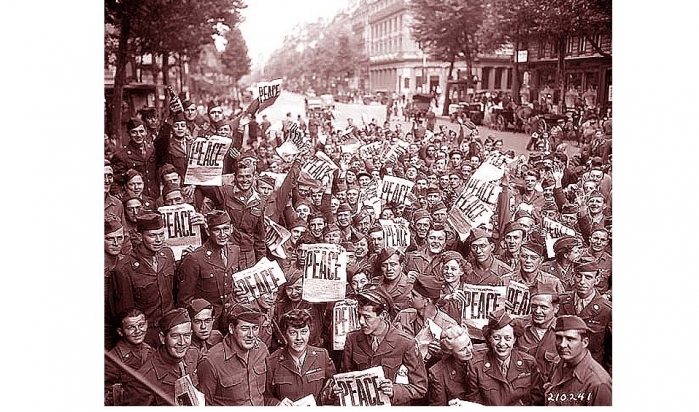
This article appeared on U.S. newsstands mid-way between the Nagasaki bombing and the Tokyo Bay surrender proceedings, and it explains clearly that the Truman administration understood thoroughly the inherit problems that needed to be addressed in choosing to occupy the charcoal and rubble-strewn streets of post-war Japan:
“U.S. troops will be dealing with a strange people of a different race. General of the Army Douglas MacArthur, as commander of the American Army of occupation, will give orders to the Japanese people through their Emperor. The American policy will be to maintain order and avoid revolution…Immediate problems of reconstruction will be acute. Hunger is widespread, industry is blasted, unemployment is serious. These problems are certain to get attention.”
“The big question for the United States is how long American troops are to occupy Japan. The Potsdam Declaration says that the occupying forces of the Allies shall be withdrawn from Japan as soon as the objectives outlined are accomplished and ‘there has been established in accordance with the Japanese people a peacefully inclined and responsible government.'”
“U.S. officials appear to be thinking in terms of an occupation of only 5 or 10 years. Japanese officials, however, in looking ahead to a resurgence of Japanese power, appear to be thinking in terms of 50 to 100 years.”
Read about the German POWs who were schooled in the virtues of democracy.

![The U.S. Occupation[br] of Japan](https://oldmagazinearticles.com/pdf/Japan_US_News_1945_0001.jpg)
![The U.S. Occupation[br] of Japan](https://oldmagazinearticles.com/pdf/Japan_US_News_1945_0002.jpg)
![The U.S. Occupation[br] of Japan](https://oldmagazinearticles.com/pdf/Japan_US_News_1945_0003.jpg)
![The U.S. Occupation[br] of Japan](https://oldmagazinearticles.com/pdf/Japan_US_News_1945_0004.jpg)
![The U.S. Occupation[br] of Japan](https://oldmagazinearticles.com/pdf/Japan_US_News_1945_0005.jpg)