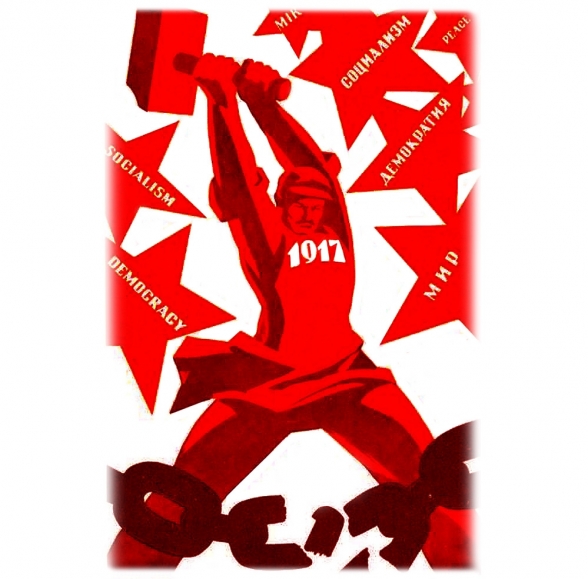
Here is Leon Trotsky's reminiscence of those heady days in 1917 that served as the first step in a 75 year march that went nowhere in particular and put millions of people in an early grave - this is his recollection of the fall of the Kerensky Government and the creation of the Union of Soviet Socialist Republics(R.I.P.).
- from Amazon:

"THE REVOLUTION was born directly from the war, and the war became the touchstone of all the revolutionary parties and energies..."
The review of the first English edition of Das Kapital can be read here...
Appearing in the pages of a slightly left-leaning New York paper was this obituary of Leon Trotsky (1879 - 1940):
"Thus, at 9:25 last night, ended the life of the man who, with Lenin, brought about the world's most profound revolution and with his death, ended the bitterest of modern feuds - Trotsky against Stalin." When Washington D. Vanderlip made his way to the nascent Soviet Union to secure mining rights in Siberia he wrote of his meeting with the nation's first dictator, Vladimir Lenin, and revealed a Lenin that was seldom seen in print. He wasn't blathering on about the proletariat or the bourgeoisie but rather musing about his pastimes and dreams for the future.
"On his desk was a copy of the New York Times, well-thumbed. 'Do you really read it?' I asked. 'I read the New York Times, the Chicago American and the Los Angeles Times regularly,' he said.'Through the New York Times I keep track of the atrocities, the assassinations and the new revolutions in Russia. Otherwise I wouldn't know where to find them.'" Victor Serge (1890 - 1947) was a devoted Bolshevik writer who was highly critical of Joseph Stalin; he spent five years in the gulag for his "subversive activity" and would have no doubt died there had not an international mishmash of humanitarians raised a stink about his incarceration. He was exiled from the Marxist-dream-land in 1936 - the attached column is an extract from his gulag writings concerning the cruelties of Stalin's secret police. |