A well-illustrated 1944 article by Leonard Lyons pertaining to the assorted wartime experiences of ten American war correspondents: - from Amazon:
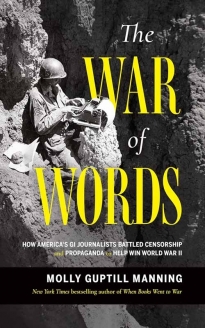
• Martin Agronsky for NBC News
• Vincent Sheean with The N.Y. Tribune
• Henry Cassidy of the Associated Press
• Bob Casey of the Chicago Tribune
• John Gunther of The Chicago Daily News
• Jack Thompson of The Chicago Tribune
• Cecil Brown of CBS News
• W.L. White of the Associated Press
• Quentin Reynolds of Collier's Magazine
• Cyrus Schulzberger with the NY Times
Published four months after the above article, here is a similar, well-illustrated piece that lists the names of the photographers and reporters who were killed - and the younger breed of writers and lens-men who took their places. This article was penned by Yank correspondent Evans Wylie; it is an account of Ernie Pyle's (1900 - 1945) surprise appearance during the Okinawa campaign and the violent death that Pyle had long anticipated for himself. His end came while he was being driven along a road in the company of Marines in a sector that was believed to have been safe.
Of all the many American war correspondents writing during World War II, Pyle was, without a doubt, the most well loved; he was adored by readers on the home front as well as the GIs in the field. Like many men, Pyle struggled in his career as a younger man; yet when the war broke out he very quickly found his voice - and his readership soon followed.
Two months after the death of Ernie Pyle, United Artists released a movie about him; Click here to read about it...
This brief column tells the story of three women war correspondents who marched at the point of the spear alongside the American infantry in order to report on the collapse of Hitler's Germany. The correspondents in question were:
• Lee Carson in Remagen
• Iris Carpenter in Remagen
• Ann Stringer in the city of Bonn
- from Amazon: What's a Woman Doing Here? "Never had so many correspondents (450) poured so much copy (millions of words) into so many press associations, photo services, newspapers, magazine and radio stations (115 organizations in all). Representing the combined Allied press, some 100 reporters covered every phase of the actual battle operations. Their pooled copy started reaching the United States within four hours of General Eisenhower's communiqué."
The first newspaper to get the scoop was The New York Daily News (circulation 2,000,999). The First radio station to announce the news was WNEW (NYC).
Click here to read about the extensive press coverage that was devoted to the death of FDR...
CBS war correspondent Betty Wason (1912 - 2001) reported in a very chatty way about how the war was proceeding along the shores of the Southern Mediterranean Sea. Of particular interest was her observation regarding how thoroughly lame the Italian Army appeared to their opposite numbers in the Albanian Army. Rather than eliciting feelings of dread and hatred, the Italian soldiers were pitied for their poor skills - their bodies were plentiful on every battlefield. |